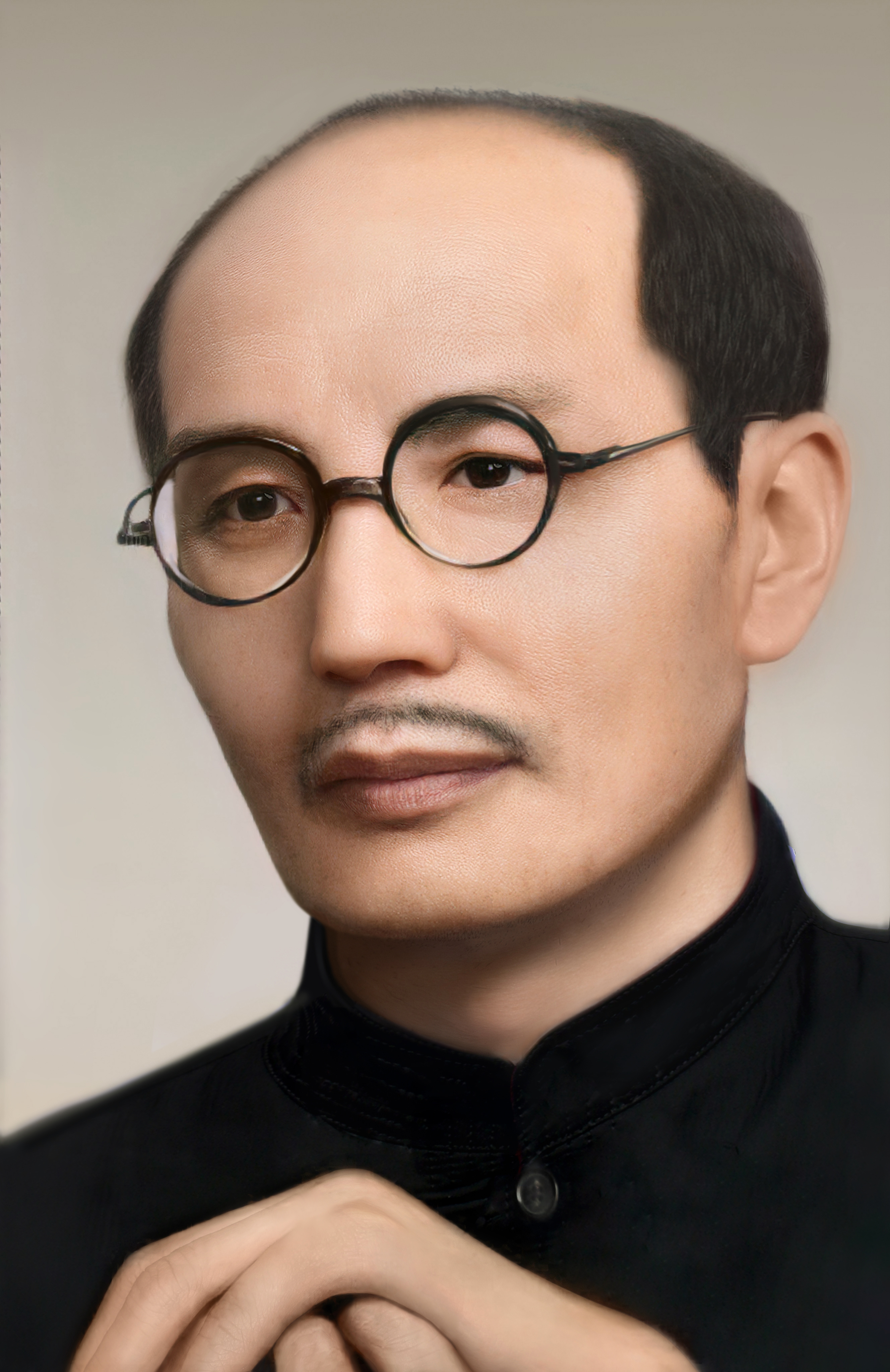
Venerable Master Dayu
First Patriarch of the Heart-of-Heart Dharma Lineage
Venerable Ācārya Dayu, a descendant of the Li family in Wuhan, bore the given name Shubei (Zongtang) and the alias Shi’an. During the warlord era he served in the government and witnessed the warlords fight over territories, slaughter each other, plunder people’s belongings while turning a blind eye to the grave sufferings of the people, in order to gain power and reign supreme. Heartbroken and devastated, he denounced his government position and left to become a monk at the Donglin Monastery on Mount Lu.
He started with the Pure Land practice, followed by sutra recitation while prostrating. He almost lost his life from a grave illness and was on the brink of death when he encountered bandits. In the face of repeated adversities, he never let up on his practice.
He then came to realize how fleeting life can be and how rare it is to encounter Buddhism. So, he resolved to embark on the practice of Pratyutpanna Samādhi (Interpreted as “the Samādhi in which the Buddhas appear standing before one”, this practice is followed in sessions of seven or nine days, during which one engages in continuous walking meditation day and night, without sitting or lying down. The practitioner will thereby perceive the Buddhas of the ten directions appearing and standing before oneself in space.)
After three to five days, his legs became so swollen he could not move an inch. The Master adhered to his initial goal and refused to back down. He gritted his teeth and began to crawl on his hands and knees. After another day or two, his hands also swelled up. Every single step took a tremendous amount of effort. The suffering involved is truly beyond what an ordinary person can endure. Thus very few practitioners of the Pure Land school follow this practice, and even if they do start, they cannot persevere until the end.
When the master was completely exhausted and could no longer crawl, he vowed to continue only upon death and started to roll his body forward. After this extraordinary struggle of the utmost difficulty, the last bit of his ego evaporated, and he entered into a deep state of samadhi. He felt the presence of Samantabhadra Bodhisattva, who bestowed empowerment upon him, and imparted the Mind-seal tantric teaching.
Bodhisattva Samantabhadra also told the Master that this method originally existed in the 'Tripitaka' and is very expedient and efficient. The Master verified this to be true and started the practice of six mudras and one mantra described in the 'Secret Rituals of the Tripitaka: The Buddha Heart Sutra, also known as the Great All-Encompassing Dharani' bestowed by the Bodhisattva (two volumes, translated by Bodhiruci in the Tang Dynasty). After seven years of diligent practice, he achieved realization and descended from the mountain, establishing the Mind-seal teaching. He is the founding master of the Mind-seal school.
After the Master descended the mountain, to call attention to this effective and convenient dharma method to the world, he demonstrated a bit of his supernatural powers wherever he went. This took people by storm across areas north and south of the great river. At the time, dharma seekers numbered in crowds no fewer than fifty or sixty thousand, with almost two hundred close disciples.
Subsequently, as the vast majority of his followers valued supernatural powers over the dharma, the Master changed out of his robe and retired into seclusion retirement in Chengdu, Sichuan. He entrusted his disciple, the elder lay practitioner Xianglu Wang, who had received essence of his teaching, to inherit the Dharma and propagate the teachings. Master Wang was later revered as the Second Patriarch of the Mind-Seal School.
Sometime in the 1950s, Acharya Dayu left a poem in the home of one of his disciples in Chengdu:
How to teach the flower-holding dharma
Why not go through tantric to Zen
Retire into seclusion with the raise of an eyebrow
Encounter it with the blink of an eye
Once you follow the ancient vessel
You can sleep carefree across the three realms
Upon my departure no words are left
Just “take care of ○”
He placed the poem beside an ink slab and left without saying goodbye. No one know where he went to this day. In his Dharma teaching, the Master valued direct pointing to the essence of the mind, without relying on words. Apart from the Song of Liberation composed in his early years, this farewell poem is the only written work he left for the world.
Narrated with respect in winter of 1993
by disciple Yuanyin